
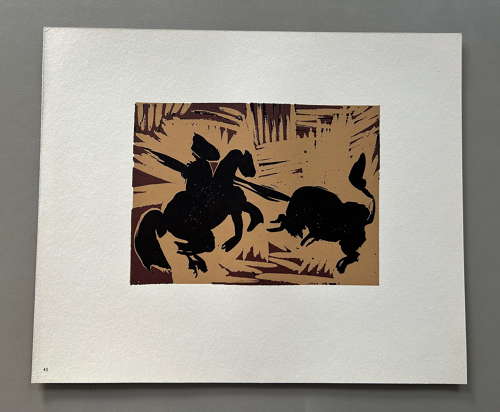


A Linocut from the 'Picasso Linogravure' Series of 45 Linocuts (B)
Code: 13267
A linocut from the ‘Picasso Linogravure‘ series of 45 linocuts by Picasso showing Bullfighting Scene printed from linoleum blocks re-carved at 42% of the original size included in the unsigned edition published in 1962 by Éditions Cercle d’Art, Paris and Harry Abrams, New York, incollaboration.
NOTE: There are two other linocuts with bullfighting scenes on our site. The three £1350
Medium – Linocut with Date of Work – 1962
Dimensions
Sheet Size: Height: 32cm and Width: 38.5 cm. Image Size Height: 16.5 cm and Width: 22.5 cm
Linocuts with Bullfighting Scenes
Some of the artist’s most personal subject matter and symbols abound in Picasso’s bullfight linocuts. Like so much of his art, there is a cyclical and serial aspect to them. He repeatedly explored the bullfight, for example: this confrontation being part of his deep cultural past, rekindled by its introduction in Vallauris in 1954, where, significant to Picasso’s humanism, killing the bull is prohibited. Picasso expresses the subject with a thoroughness that recalls the aquatints and lithographs of his countryman, Francisco Goya, but without the bitter violence. No other series of graphic works, aside from Goya’s, explores with such range the
duality of man and beast in the arena.
General Introduction
The story of Picasso’s linoleum cuts began in Vallauris, the little village above Cannes where the artist had made pottery since 1947. On behalf of Vallauris, Picasso occasionally accepted civic responsibilities of an undemanding nature. In 1951 and continuing through 1964, he annually contributed posters that were used to advertise the town’s ceramic crafts and bullfights.
Hidalgo Arnéra, a local printer, suggested that Picasso try linoleum to make such posters, since it could be inexpensively printed. As Picasso continued to explore linocut, he realized that the medium need not be limited to the manufacture of posters and that it offered many additional possibilities. The facility with which it responded to decorative and cursive design particularly attracted him. Also, colours printed from linoblocks are characteristically flat and opaque – unlike any that Picasso had previously employed. In linocut more than any other print medium, Picasso desired to create images in colour.
Of the thousands of prints that he created in his lifetime, Picasso is known to have made only about 150 linocuts. 100 of those were made between 1959-1962, during the time he was living in Vauvenargues and Mougins in the South of France.
This particular collection of 45 linocuts to which our linocut belongs were printed from blocks that were re-carved at 42% of the size of Picasso’s larger works from the late 1950s and early 60s. This extraordinary achievement was overseen by Picasso in collaboration with the Galerie Louise Leiris, Paris and the end result was entitled Picasso linogravures, published in 1962 by Éditions Cercle d’Art in Paris and Harry Abrams in New York.
Showcasing the artist’s inventiveness with the medium, from line drawing and complex multicolour prints to textural marks never before seen in lino printing, Picasso linogravures helped to elevate the humble status of the linocut as an art form.
Picasso was keen to print in colours, enjoying the expressiveness and ease of carving lino, as well as the resulting solid areas of dense, flat colour. However, the process of colour printing with lino in layers was laborious, requiring a new block to be carved for each colour and each block to be perfectly registered for each layer. Picasso soon abandoned this way of working and invented ‘reduction printing’ or the ‘suicide cut ‘- a method still used by artists today as a more efficient way of printing many colours successively from one block. There is no room for error with this method, as there is only one opportunity to print each layer
from the block before it is cut away, however it eliminates the need to register each part of the design with a different block for each colour.
The subject matter in this series is typical of Picasso’s personal mythology including bullfights, nudes, musicians and bacchanalia. Links between the themes in these prints can be made with Picasso’s earlier works such as the Antibes Murals of 1946 however, they are uniquely portrayed in this portfolio in a wonderful form of printmaking, which Picasso made his own, in a relatively short period of furious experimentation and innovation.
Compared with the several thousand etchings or over eight hundred lithographs Picasso produced, his linocuts occupy a relatively small place in his graphic canon but the impact of this rarer linocut work and its influence on printmakers is still widely felt today. Picasso’s larger linocuts currently sell from £6,000 to over £100,000, making these smaller versions an affordable way of enjoying the Spanish Great Master’ Picasso’s celebrated images and his astonishing ingenuity with printmaking in the home of a collector at an average current price (2024) of £750.
Bio Note on Pablo Picasso
Pablo Ruiz Picasso (25 October 1881 – 8 April 1973) was a Spanish painter, sculptor, printmaker, ceramicist and theatre designer who spent most of his adult life in France.
Pablo Picasso was born in October 1881 in Málaga, Spain. The son of an academic painter, he began to draw at an early age and although he attended art schools throughout his childhood, he never received a formal degree and left the Academy of Fine Arts in Madrid after one year of study. In 1900, Picasso’s first exhibition took place in Barcelona. Picasso settled in Paris in April 1904, and soon his circle of friends included Guillaume Apollinaire, Max Jacob, Gertrude and Leo Stein, as well as two dealers, Ambroise Vollard and Berthe Weill.
As if to distance himself from his imitators, Picasso then went to the opposite extreme of embracing the classical past. He expressed a renewed interest in drawing and figural representation and in 1932, with large exhibitions at the Galeries Georges Petit, Paris, and the Kunsthaus Zurich, and the publication of the first volume of Christian Zervos’s catalogue raisonné, Picasso’s fame increased markedly.
One of the most influential artists of the 20th century, he is known for co-founding the Cubist movement, along with the French artist Georges Braque, Picasso broke down and analysed form as ‘little cubes’, ushering in the age of Cubism. It proved to be the most influential movement of the early twentieth century.
He is also acknowledged as the inventor of constructed sculpture, the co-inventor of collage, and for a wide variety of styles that he helped develop and explore.
Among his most famous works are the proto-Cubist, Mademoiselle D’ Avignon (1907) and the anti-war painting Guernica (1937), a dramatic portrayal of the bombing of Guernica by German and Italian air forces during the Spanish Civil War.
Picasso demonstrated extraordinary artistic talent in his early years, painting in a naturalistic manner through his childhood and adolescence. During the first decade of the 20th century, his style changed as he experimented with different theories, techniques, and ideas. After 1906, the Fauvist work of the older artist Henri Matisse motivated Picasso to explore more radical styles, beginning a fruitful rivalry between the two artists, who subsequently were often paired by critics as the leaders of modern art.
Picasso's output, especially in his early career, is often classified into periods, While the names of many of his later periods are debated, the most commonly accepted periods in his work are the Blue Period (1901–1904) and the Rose Period (1904–1906), so-called for the colour tones in which they are rendered. With their wistful elongated figures of Spanish and French life, they are examples of late 19 th century Symbolism.
The African-influenced Period (1907–1909) is marked by the influence of Greek, Iberian and African Art. Analytic Cubism (1909–1912), and Synthetic Cubism (1912–1919), also referred to as
the Crystal period are next two genre in this periodic classification.
Much of Picasso's work of the late 1910s and early 1920s is in a neoclassical style, and his work in the mid-1920s often has characteristics of Surrealism. His later work often combines elements of his earlier styles.
Picasso was an innovator in every art form that he worked in, from painting, to ceramic, to printmaking. As with all those these other techniques he used, with linocuts too he pushed the boundaries of the possible, and made the medium, which he had taken up seriously well into his late 70s, his own.
In the decades following World War II, Picasso continued to produce paintings and prints of considerable power, always remaining relevant and influential. As the first artist to enjoy the attention of mass media, his restless changing of style and love of controversy projected him into genuine superstardom, perhaps never to be surpassed again in the art world. He died in 1973 at the age of 91.
Exceptionally prolific throughout the course of his long life, Picasso achieved universal renown and immense fortune for his revolutionary artistic accomplishments, and became one of the best-known figures in 20th-century art.
At his death there were more than 45,000 unsold works in his estate, comprising 1,885 paintings, 1,228 sculptures, 3,222 ceramics, 7,089 drawings, 150 sketchbooks, many thousands of prints, and numerous tapestries and rugs. The most complete – but not exhaustive – catalogue of his works, the catalogue raisonne compiled by Christian Zervos, lists more than 16,000 paintings and drawings. Picasso's output was several times more prolific that of most artists of his era.
